 Justin Kazmierczak
Nov 25, 2026 · 10 min read
On Friday I was sitting in a client meeting, helping them bring a new line of business under one roof. We were talking about integrations, about moving everyone onto Microsoft or Google so every person and every team would finally speak the same language. That's the part of any integration I care about most. So we went to set it up, and everything Microsoft was down.
Microsoft had gone down the day before. I had noticed, and I assumed it would be back by now. It wasn't. When I told them, the room changed. Oh, that's why my emails aren't coming through. That's why this isn't working. Nobody had told them. Outlook doesn't say "we have a serious outage, come back in an hour." It says send/receive failed. So people do what years of office life have taught them to do. They hit the button again. And again.
If something breaks, people are going to keep breaking it.
I don't blame them. Twitter's "over capacity" fail whale, a fixture of the late 2000s, did something important. It was a polite way of saying: come back later. Every retry you send to a system that's already drowning makes it drown a little faster. Google, Amazon and Microsoft all warn their engineers about this: retry too fast and a wobble turns into an outage. Their advice is to wait a little longer each time, with a bit of randomness, so the retries don't all land at once.
A week of red
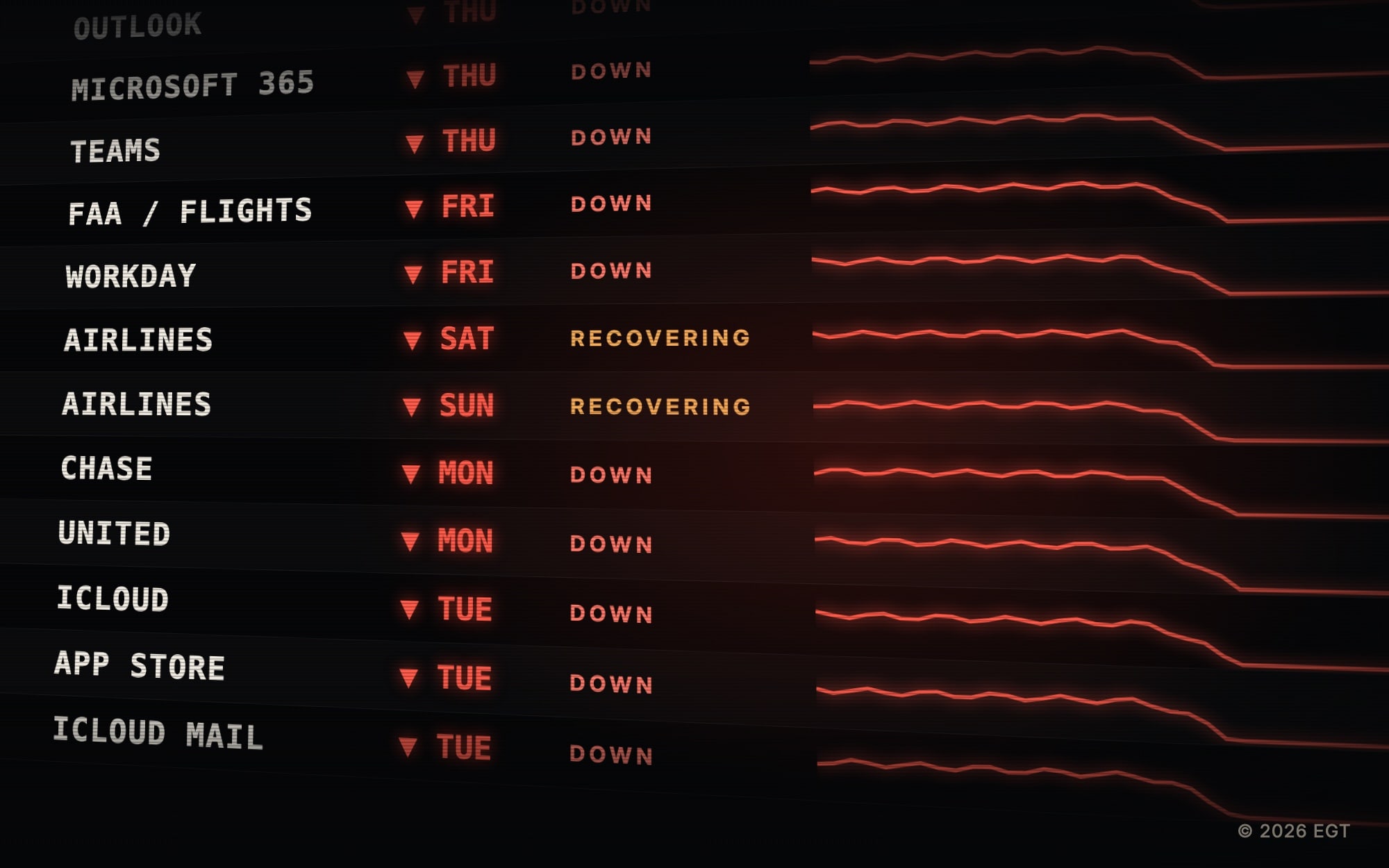
Then I opened Downdetector, and it looked like the stock market on a bad day. Outlook, Teams, Microsoft 365, iCloud, Apple Pay, Chase, Zelle, airlines. Row after row of red.
Was it connected?
That was my first thought. There's no way all of this goes down in one week by accident. I have seen half the internet fall over before, but that was when a giant cloud provider failed and took everything built on top of it down with it. When AWS went down in October 2025, most of my day went with it: email, the AI tools I use, all of it. This was different. These failures came at different times, in different companies, on different systems.
So far, nobody has found a common cause. Every company named its own. Investigations are still open, so nobody can honestly say they weren't connected either. But here is what I see, and what worries me more than a single cause would: they're the same kind of failure. Routine work, like an update, a router install or a backup test, hit a weakness nobody knew was there, in something a lot of other things depend on, and the failure spread. That's the most common way big outages start.
It seems like we rolled the chaos jackpot.
We drew snake eyes on a lot of dice at once. But the dice are loaded the same way everywhere: everything leans on a few huge shared systems that no one person can see all of.
The server that was just a little slow
Microsoft's own account says requests piled up until servers stopped responding, its traffic systems moved users to the next healthy servers, and those were overwhelmed too. Part of the fix, by its own timeline, was a different health check.
Someone told me Microsoft's checks pulled a server just because its requests got a little slower, without asking why. I saw that all over social media. Honestly, it's probably someone's misreading of how load balancers work, and Microsoft hasn't said how its checks are measured. Its final report was due November 20 and hadn't appeared when I wrote this.
The question underneath it still stands, though. A server that's a little slow usually isn't broken. It's busy, or stuck on one runaway job, or it needs a restart. Pull it out of rotation and its traffic lands on its neighbours, which were already busy. Now they're slow too. Google's own guide for engineers warns about exactly this: routing away from servers that look unhealthy "can exacerbate problems further."
That's why we built it differently. In our platform, every process reports its own health: how hard it's working, how much memory it's using, where it's stuck. Once a server passes a set level, it stops getting new requests until it comes back down. It's part health check, part gate. The goal isn't to throw the server away. The goal is to let it get healthy again.
Everything inside the Universe is knowable.
"Fixed" isn't the same as back
None of these outages lasted for days on its own. But the damage outlived the fixes.
The FAA said its system was stable on Friday night. Airlines then spent the whole weekend digging out, with thousands of cancellations on Saturday and still hundreds more than normal on Sunday, because planes and crews were in the wrong places. The FAA's own line was that recovery "will be slow and steady." Microsoft said it had extended its email timeout window to 48 hours, so delayed mail would arrive late instead of bouncing.
As I write this, some of my clients are only now sending and receiving normally. I've sent emails that never bounced and never got an answer, and I have no idea if they arrived. Put the week side by side, and something big was down or still recovering every day from Thursday to the next Tuesday, weekend included.
The week in numbers
- 17 of 22FAA en-route centres destabilisedFAA
- ~24 hoursMicrosoft 365 core outageMicrosoft, preliminary
- 6,600+US flights cancelled Saturday, the day afterFlightAware via AP
- 48 hoursMicrosoft's extended email timeout windowMicrosoft status page
A backup of a backup of a backup
I have a saying: get a backup of a backup of a backup. And a backup you've never tested isn't a backup.
Workday's outage started during the very thing that's supposed to prevent outages, its disaster-recovery work. That's the honest twist. Testing your fallback is risky too. You still have to do it.
Around 2010, at a company I worked for, we built a mail queue system and didn't have a lab to test it in. So we tested it live, carefully. We had a small group of people blast it with email, and then we unplugged it. We wanted to know if the queue held, if the database kept track, and what happened while the relay was dark. It held. It waited, and after about six hours it recovered on its own. It didn't keep pounding on the thing that was down.
It wasn't retry, retry, retry. It was: okay, this system is down, now I have to wait and test.
Today I'd rather test on real equipment in a lab sealed off from the internet, a Faraday cage of sorts, where you can turn things off, flood it with load and watch what breaks. Netflix made this famous. In 2011 it described Chaos Monkey, a tool that randomly switches off its own production servers during working hours, so failure gets practised. We're doing our own version of that right now, breaking the platform on purpose before customers can.
When the change isn't yours
Industry surveys keep finding the same thing: a large share of major outages start with a change. Sometimes it isn't even your change. We had a mail system we called Postman. It ran for nine years and never missed. Then Gmail and Yahoo started requiring new email authentication, records called DKIM and DMARC. I never saw it coming. One day our clients' emails stopped arriving, or landed in spam. I stayed up for the better part of two days rebuilding Postman to support it for every client, then waited on DNS changes to spread across the internet. Nothing on our side had changed, and it still broke.
The internet should not work that way.
That's the world we're in. You swap a router, switch the backup to primary, and lose everything. There are almost no guarantees that thing one will behave like thing two.
Did we forget, or did it get too big?
I'm not saying Microsoft's engineers don't know what they're doing. They do. What I'm saying is that the systems grew faster than anyone can hold them in their head.
When I started, you had to know the difference between 7-bit and 8-bit characters and track every byte, because memory and disk were expensive. Today a single feature might pass through a cache on top of another cache, on top of a query layer, an AI layer, a front end and a back end, each with its own language. Pile up enough of those and you don't have an architecture. You have duct tape.
The programmer is less involved in the actual coding, but they need to be much more involved in the architecture.
When I built the first version of our platform, I built it stateless, so no login or checkout lived on one particular server. If the login server died, the others simply took over. I also wrote my own tests, deliberately plain: yes or no, one function at a time. Repeatable code gives you repeatable results. And when an error repeats, you know you have an architecture problem to fix.
Agents aren't functions
AI makes all of this faster, which is exactly why the architecture matters more. You can put the same prompt into an agent twice and get two different answers. That's not a function.
An agent that did something great yesterday is not going to do it great today.
It's a wild card, and you build around it: agents never get near live keys, every change is reviewed, and a person decides. I learned that one the hard way.
The other thing I worry about is knowledge walking out the door. Key people burn out. Their documentation sits in a folder on a desk that someone clears out three months later. Nobody was trained underneath them, because nobody had time to train anyone. AI is an extraordinary tool, and it still needs someone who knows the business.
It doesn't know your business. It doesn't understand your struggles, at least not yet.
One spine, many rooms
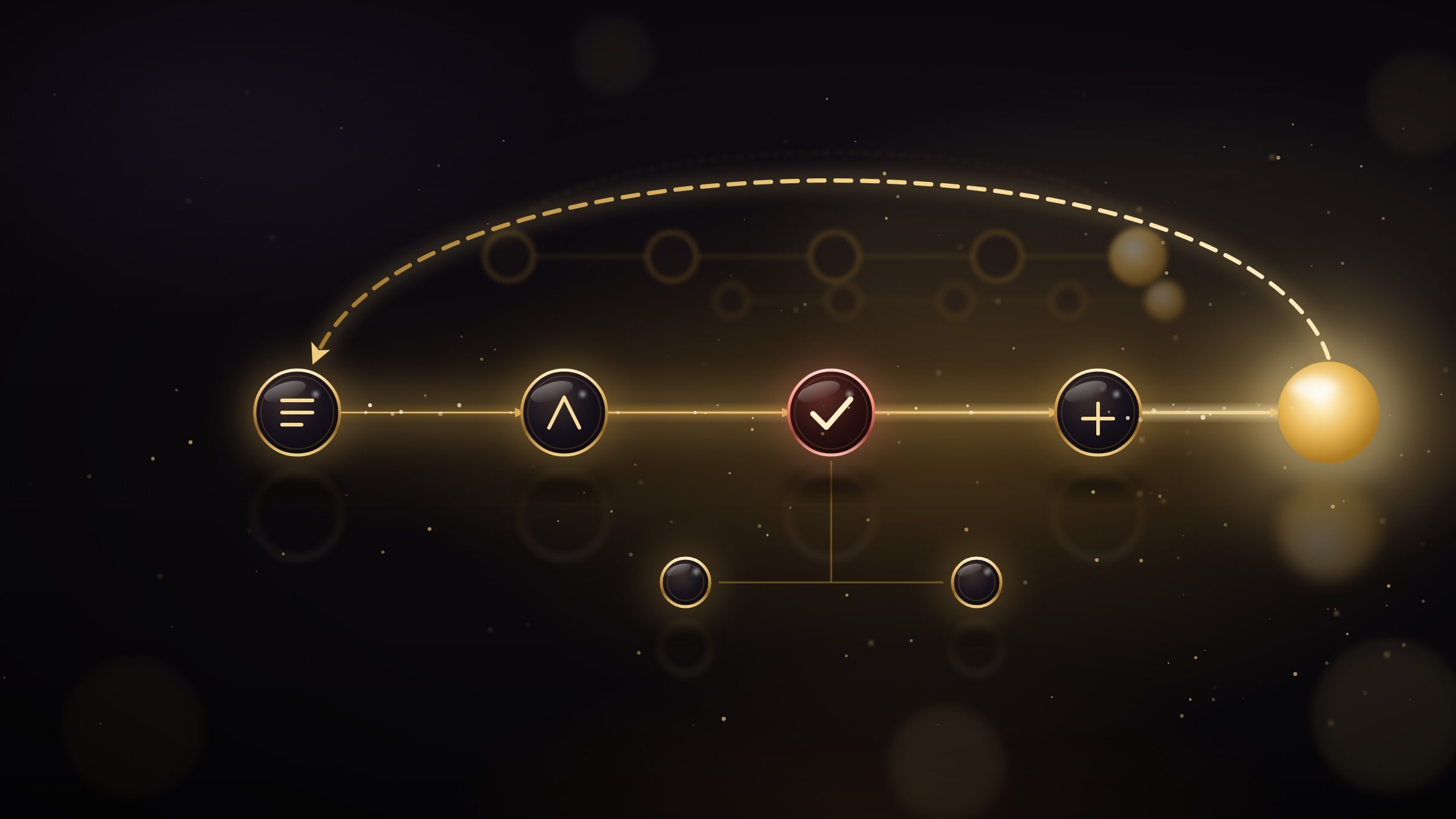
The fair question for me: the Universe has one foundation too. One rule book, one set of building blocks everything is built on. Isn't that the same shape that failed this week?
Here's how I think about it. Everything shares the spine, but each piece runs on its own, does one job, and can be switched off without taking its neighbours down. That's how version one has run for years. Version two keeps the same principles and adds many customers on the same platform, so each piece still lives in its own room. I don't want to say that's better. But it keeps everything in the box, and as long as the box is designed right, a bad day in one room stays in that room.
Might as well be Greek
The first time a blue screen stopped me, I had just updated a driver. It crashed in the middle of my work, back before anything saved itself. All I had was a code made of long hex numbers. It's a perfectly good identifier for a machine, and it might as well have been Greek to me.
That memory shaped how we handle errors. In our platform, everything from a single function to a whole service reports errors the same way. I can type in an error's ID and see where it came from, what caused it and what it was doing. When the next bad day comes, and it will, I want to know where to look in minutes, not days.
Things will fail. Things will explode.
If it's broke, fix it
No amount of backups or planning stops every bad day. This week, every big system seemed to have a gremlin in it at once.
You can still build so the gremlins stay small. Know what your system is supposed to do, even if you never read every line of its code. Know how its parts talk to each other. Test the backup. Let a struggling server rest instead of throwing it away. And when you hand the work to AI, don't hand over the understanding with it.
You can't sacrifice understanding how systems talk to one another.
If it's broke, fix it. If it ain't broke, don't fix it. Just make sure you'd know the difference.