 Justin Kazmierczak
Oct 21, 2026 · 6 min read
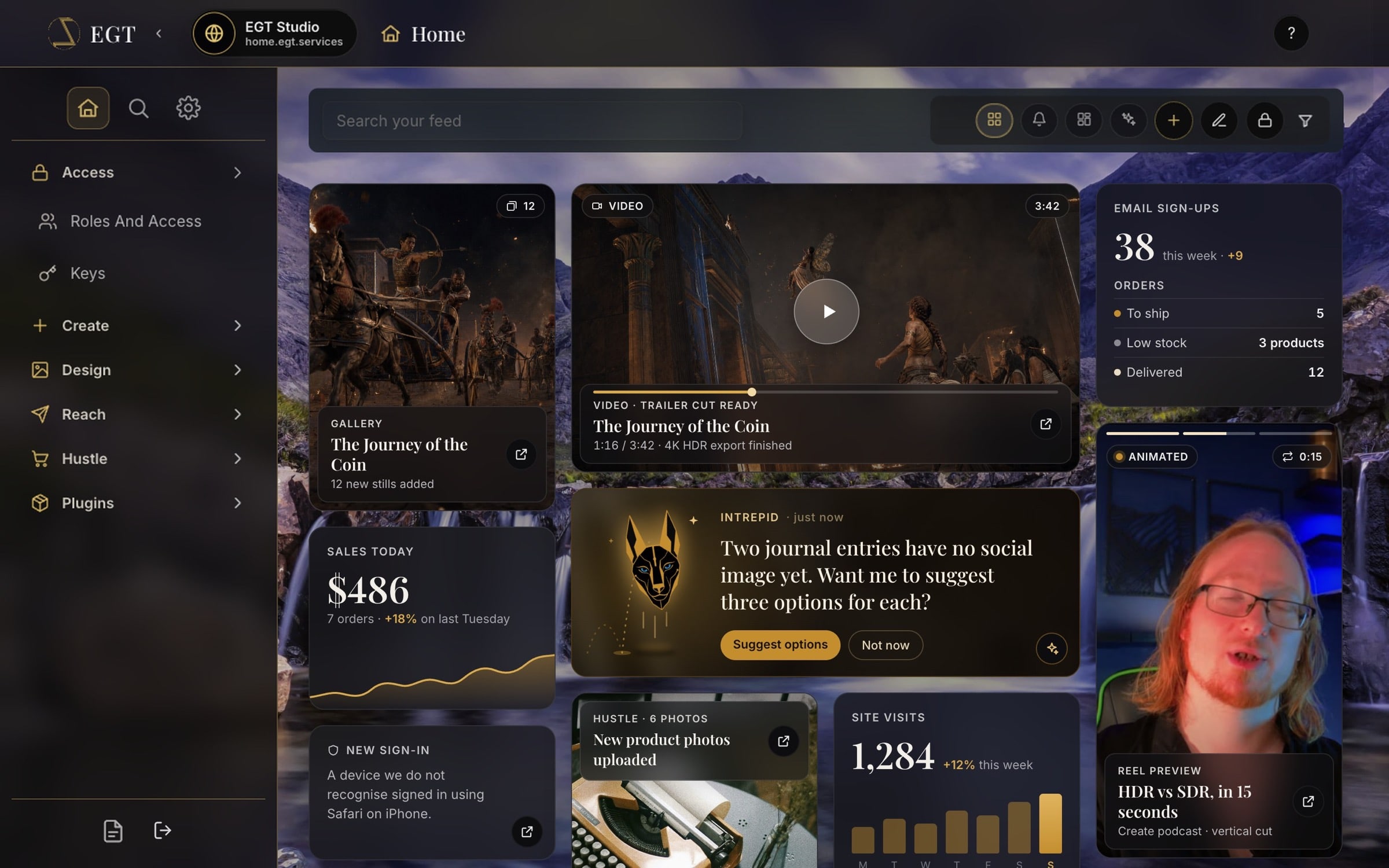
I was on a client site when a colleague happened to stop by. I showed them a screenshot of the new Universe dashboard and asked what they thought.
Wow. Almost mind-blown.
That reaction is what I want. It rarely comes from anything a person could point to. It comes from the details nobody notices on their own, and those details are the whole point. They exist to protect one moment: the moment the vision, the message or the call to action reaches the person on the other side of the screen.
Every corner on purpose
I want people to think about the details in the Universe platform. The rounded corners. The frosted glass. Buttons that are nothing but an icon. Toggles that stay simple. Actions that take one click. The context focus dialogs, which I created. Playfair as the typeface. A brand I keep elevating and keep watch over, built to showcase the creative work.
I have spent hours trying to perfect the look and the aesthetic of the Universe. Beneath the glass sits the back end: hours and hours of coding in version one, then testing, then performance testing.
Nobody looking at a screenshot lists any of it. All of it sits behind the wow.
It is essential to my personality to be that kind of person.
Fifteen amps
The habit doesn't stop at software, and it doesn't stop at video editing. I bring it to client work of every kind.
One client had a TV truck. Someone had installed circuits in it, and the plan was to plug everything in and call it a day. The installation looked great. Technically, all I had been handed was a list and a question: is this what we need?
My answer was no.
I went past the list and checked the details. At the breaker box, nothing was labelled. We started flipping off breakers to work out what was what, because we needed proper power distribution. Here is what we found. Several breakers had been installed, and all of them were wired incorrectly. Literally everything ran to one 15-amp breaker.
I still find that unbelievable.
We ended up as part electricians, guiding them through circuit flow and how to use voltage meters. We worked through it together and made sure they were good to go. Looking great and being wired right are not the same thing, and the technology should never fail because of a human mistake.
Trained eyes
In video, we say it all the time: no one's going to know. No one will know there's a mis-framed cut. No one will know the quality is different.
I know. I work in 4K, and when someone hands me 1080 footage, I see the difference myself. Nobody else can tell. HDR matters to me a great deal.
Other people do catch it now. Many of the people I work with side by side, I trained. It was never an official role, but I gave them my time, worked alongside them and spent personal time with them. My nine- or ten-hour days would stretch to fourteen, because I wanted the people around me to succeed. Now they're sharp.
Audio is where it got personal. I remember struggling to get pieces remixed properly and fighting over the bass levels to get the impact and the feeling right. I believe bass sits closest to the heart. With the right mix, you hear it. The vocal doesn't just sit on top of the music, and the music isn't dropped to almost nothing. Music is an essential emotional component of a piece. Without it, you just have someone talking. The music moves you.
When the people around me couldn't deliver, I had no way to step in. Deadlines were the worst. A last-minute video would come in with no time to send it out for a remix, and they would have to play something that sounded so bad I would cringe and never hear the end of it.
I forced myself to learn. I finally asked someone to teach me. I told him I didn't care what time he had: I wanted eight and a half hours of it, the two of us in my office, and he was going to teach me how to remix. He started me on the basics: compressors, audio levels. Eight and a half hours was the goal. It took about six.
Then came the trial and error. No, that doesn't work. No, that doesn't work. For a while I would send a piece out to be remixed, then compare the file that came back with mine and study the difference.
To me, audio is 60 percent of a video experience. When you feel a story, it's because you're hearing it, not because you're seeing it. The visuals help. That's why, in my short film The Journey of the Coin, I focused on the soundscaping.
What it costs
The standard has two sources. Half of it, honestly, was inspired by God. The other half came from other creatives who, with their words, took a frying pan to the back of my head. When people told me I was a failure and bad at my job, I took it as an admonition to keep going. I kept striving and I kept building. It hurt in the moment, and many times I had to go to God in prayer. I still do. It is not possible for me to be a failure at media. That is the vision and purpose God gave me.
That standard has a price, and most of it is paid where nobody sees.
There was a performance piece I had to build. I worked on it for hours and hours, slaving over it, and for three months I barely left the studio, a Pro Tools recording studio. I would get up, walk home, get up, walk back. I lived there. No one knew whether I was there, and I didn't care.
On another project, three days before a new show went live, I struggled to get the team on board. I painted the studio floor myself, because the people assigned to it told me no.
No is not an option.
I ran a time study for a client once or twice. One showed 72 hours of work over two or three days. Sleep, wake up, work. Sleep, wake up, work. I wouldn't eat. To this day I have to remind myself to eat. Food going cold in my car is the most normal thing. So is a cup of coffee left so long that a fly finds it, or it goes stale and I forget it was ever there.
That is the part no one will understand. So much of my mental capacity goes into this work: making something I can be truly proud of, something the client can resonate with. The investment is enormous, and the cognitive repair time afterwards is astronomical.
Picture two batteries in your brain. One runs everyday life. The other runs the creative work. A battery is supposed to run from zero to 100. With what I put into a project, I end up at negative a thousand, and it charges slowly. I wish I had a huge support system.
It also makes it hard for me to rely on other people. It's not that other people aren't brilliant or creative. But when this much goes into a piece and someone hands me something subpar, not even close, I have to take it on myself. It cannot go out bad. It cannot pass Go, collect 200 dollars, make the client mad, let the vision fall apart and leave the story untold.
Why the details matter
The goal behind all of it is a distraction-free experience. The technology shouldn't fail because of a human mistake, and the creative experience should never get between you and the vision: the ministry you receive, if it's a nonprofit, or the call to action.
That is why the details matter. Not to make something look better or feel better, but so the vision, the emotion and the feeling land the way they should.
A wow is what that sounds like when nothing gets in the way.
That's the mark of what I do. And no one will ever know how much it took to make it happen.
---
Pull quotes (set as pull quotes; his exact words, spans in trace.md)
1. "It is essential to my personality to be that kind of person." (his 2026-10-13 addition, L3) 2. "No is not an option." (round 1, Q9)