

Create_ · Season 0 · Episode 5
Search Wars
28 Feb 2025 · 40 min
Search engines, AI, and social media are battling it out for viewer eyeballs, leaving many businesses without the ability to bring viewers in. Let's break down what a search engine is, how it works, and how conversational AI works, and we will give you some tips and tricks for using search engines and designing AI prompts.




Chapters · 10
 0:00Search Wars
 2:55Intro to Search Engines
 11:51Question and Answer Social Networks
 14:00File Searching
 16:00How a Google Crawl's Your Website
 18:41The Fall of Question and Answer Social Networks
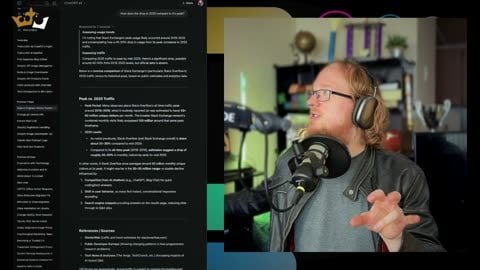 21:30How to use Reasoning AI, Using ChatGPT 01 Model
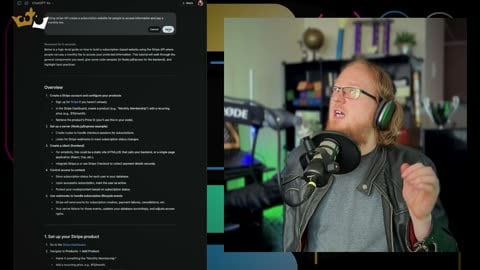 23:37How to Design Prompts for ChatGPT
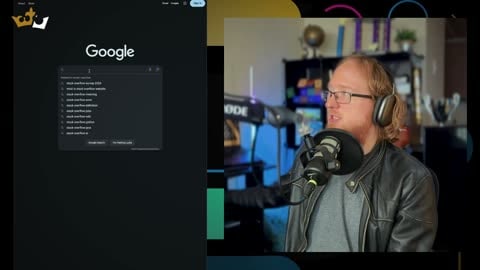 29:47Tips and Tricks to Using Google
 34:33Final Remarks
From the episode
Worth repeating
Word for word from the episode. Tap a time to play from that point.
“The search engine itself is a business plan, a business model based on other people's information.”
“The more information you provide it, the more it can hone in to a response that's going to work.”
“When you live in a world dependent on other platforms and other people and all those kinds of things, your customer base can dwindle, change, go up and down.”
Show notes
In this episode
Search engines, AI, and social media are battling it out for viewer eyeballs, leaving many businesses without the ability to bring viewers in. Let's break down what a search engine is, how it works, and how conversational AI works, and we will give you some tips and tricks for using search engines and designing AI prompts.
A long time ago in a universe not so far away...
For years, search engines have dominated web traffic, becoming the predominant way for networks of information to be shared with millions. Tricks have long enabled search engine optimizers and marketers to direct the flow of traffic to their own domains. Now, AI threatens to change the dynamic of how customers gain access to this information, shifting the landscape of the internet forever.
Let's Connect
@jumpcutking on Instagram, X/Twitter, Facebook

Transcript
Full transcript
This transcript may contain errors. About 2,988 words.
0:00 To be continued... Search Wars! Yes! The number one problem of customers finding your business, of people finding your products, your services, or most importantly, just finding files on your computer. So today, we're going to talk about a couple of very important things. We're going to talk about how to use Google Search Engine and other search engines. There are some cool tips and tricks that we're going to go over.
1:03 Then, how to do ChatGPT prompts properly. And you'd be surprised. It's a lot because OpenAI, ChatGPT, what we call large language models, which are a form of neural engines. These make assumed connections. We don't actually know how these connections are built. We just know that we train it with, here is our predicted known answers to questions. And then, we try a second set or a third or fourth set that says, okay, now here are the questions.
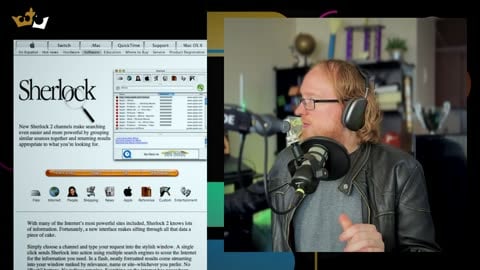
2:08 There's a way you can tailor your Google Search Engine or Google Searches or other searches to help you find things. Unfortunately, there's still no really good solution to finding products or finding files on your homepage. There is still no good solution for finding files on your computer. So, that's how it is. Unless you want to go back to Windows XP, we all have this new thing called Spotlight.
3:09 Just files on random clusters of computers that you could use, if you use a network IP address, that you could try to browse. Then things called indexes were formed. That's where we get our homepage from. Indexes would just be a text index, a list of links, directing people to research papers and information on that particular computer. Eventually, we had the onset of the requirement of being able to find webpages.
4:13 And the algorithms that generate these search results and these things that index your website and large files are much more complex than they were in the 1990s. Think of it this way. The amount of power and the ability is almost tripled. So, then we have the rise of Google. Where it introduced something called page ranking. Now, if you're a search engine optimizer or SEO or web developer or you're a consultant company, you're familiar with page ranking.
5:23 Referral links. That's why there's a HTML tag called noreferrer. So, if you have no understanding if the website you're directing users to is valuable, has good reputation, or you don't control it, or you don't know or trust it, you'll add the tag noreferrer. That's what social media websites do. And most websites actually will do that in an attempt to not enhance someone else's page ranking.
6:29 And the idea was that it would assume, based off of information created from your website and other websites, what your reputation is. Now, much like in the 90s and the dot-com boom in the 2000s, that a lot of SEO and marketers would abuse the algorithm. Many people do this. You hear of clickbait. You hear, so, paying for referral links, that kind of thing. So, Google had to evolve its search engine to limit the amount of spam that would show up.
7:34 Where if you just flood web pages with hidden text of keywords and hidden descriptions of keywords and all these tactics, Google now, you know, evolves. And so, now that it deprioritized those, because it's assuming that you're trying to increase your page rank or increase your search results. And this is how search engines were designed. This plethora of connected networks, this plethora of infinite knowledge that was on all these computers and all these places that you, as a consumer, couldn't have access to.
8:36 Now, they're switching to subscriptions and AI and those kinds of things. And they're trying to grow those. They're trying to diversify because they know they're writing this on the wall for search engine indexes. Because a search engine, all it does is read and direct you to someone else's files. Like I told you, a great business model is when I can sell ads and keep you on my platform, keep you integrated into my system.
9:39 So you literally, all you're doing is curating that information or in this case, indexing. AI is more curating and creating a result that's more of what you would expect. And having to go to a website, read a recipe, go into a website, read about this technology, read about this module or this programming package. Now you can have AI create your programming and create your script. And there's new reasoning techniques and things which are all awesome in AI.
10:40 And even social media and social media optimization may become less important to building that organic reach as AI and new experiences, VR experiences and augmented reality are created. There's all these complexities to building websites. And when you were starting in the 1990s, you could do things like scrape the internet for a billion emails and send emails to people and you wouldn't have something called the CAN-SPAM Act.
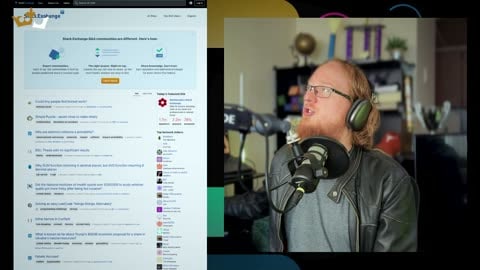
11:41 So, and eventually we grew and then we started having specialized question and answer sites. I'll show you some of them now. Of course, my favorite, okay, so this is Stack Exchange. You may know it as Stack Overflow. This Stack Exchange is a specialized network of question answering sites specific for brands. Brands, but of course you might know this as Stack Overflow. There's Google again, no sponsored results.
12:47 And it allows it to create this kind of chat experience because it's based off of chat logs. It's based off of questions and answers on these sites from things like Quora, which of course you can't see because it wants you to log in. Or other search engines that were at the time were Ask Jeeves. Okay, and all of these were designed so you ask questions and this led to a natural requirement or reasoning to building a product, much like ChatGPT.
13:47 That's it. You don't think it's going to show you your results. Don't think it's going to show you important results. It could show you biased results. It could show results full of spam. It could show the wrong website that makes people trick. All these things happen. Now, Google has gotten very advanced to prevent spam and fraud and phishing and those kinds of things. But it's all based on the idea that you need your information.
14:50 Now, I turned off web results and it would show me web results. It still shows me web results. And it shows me random files it thinks I know. And then it shows me notes, which may contain proprietary information, so I'm not going to show you the rest of this. But this is not a search engine I want. I want a list of the files on my computer.
15:56 They could pick and choose what you're searching for and those kinds of things. And that's what produced the modern view of our search engines. Now, search engine optimization, still important. I would say search engine optimization plus accessibility, very important. Because the more you make your products, your websites accessible, you're providing organic keywords in image descriptions, things of that nature that help someone that has, you know, a screen reader or something read the information.
17:09 How fast images load is JavaScript, changing the text after it's been rendered, those kinds of things to try to, A, prevent spam, but also to prioritize better experience websites. So websites that load faster, websites that are easier to navigate, websites that are more accessible, that kind of thing. So search engine optimization is kind of important still while we're bridging the gap between, Google and AI. And that should help you a little bit with understanding exactly how this, how search engines evolved.
18:12 They want you to stay on their platform. They want you to pay for the platform. Luckily it's ad free. They have not yet baked ads into it, but ChatGPT has been found to have a substantial bias in its results, which, could be good. Could be bad. That's not, that's not for this podcast, but so if we pull here, so I want to, I want to share this very important thing.
19:14 So you now ask AI a question and it responds within seconds. And especially with reasoning. So AI pretty much stole information from these question and answer sites. They'll tell you they didn't because it's, it was publicly accessible, but the reality is it's subject to copyright laws. They stole this information. They took information from public domain works. It's great. It's not stolen public domain, but then they took information of commercial works and all articles and all this vast tech, build this vast text database to train their AI.
20:19 And it's literally killed and killing question and answer community sites that I used to love. Like I no longer go to Stack Overflow myself for the past two, three years. AI, I'll go to AI or I'll do the research myself because if AI can't get it, community is going to take a while to respond. But believe it or not, I still use IRC. IRC is a relay chat network.
21:20 Get some questions and answers. Wow. It's really dead. Even, even IRC is dead. And I will admit, I haven't been back to IRC in, in a couple months because ChatGPT is new reasoning features have been awesome. So let's start with use of ChatGPT. Okay. So if you pay for ChatGPT, it's $20 a month and you get access to all of their latest models. Some of them have restrictions.
22:23 Okay. So it's going to do its reasoning, right? It's going to give you a response. It's going to set up a Node.js example, which I use Node.js, but I use a proprietary server technology that is kind of, it has Express. It has a bunch of stuff, but it's a little bit more advanced called Universe App Tools. It's not publicly available yet. So here it's going through steps on how you can make this happen, how you can build this.
23:27 Okay. So it's going through here, generating steps. And we're not going to do a programming tutorial. But, so this is your basic, your very basic question. So I'm going to go ahead. I'm going to switch over to ChatGPT4 because reasoning is going to be the best way to do it. And I'm going to go ahead and resubmit this. Now watch what happens. It's going to use React.
24:32 Didn't create a full thing. It just gave us an example of what you can use, right? I actually don't like this code editor. So what I recommend in all of your ChatGPT questions is to be as specific as you can. So we'll say my updated one is, okay, I'm not going to have you, AI, build me a user interface. You don't know how to do that very well.
25:41 And I want to spend less than $50 on the ingredients or stuff like that. And it, the more information you provide it, the more it can hone in to a response that's going to work. Otherwise, you're going to have to keep going with rounds with this or you'll get a response that's very generic. You have to think of this. When question answering sites were created, a lot of people would ask the same question.
26:43 We'll go back to the reasoning model in a second. Okay, here it goes. It's producing it. Okay, you know, you need all the Stripe information. It's an API. You get all that. Okay, great. Here's my Create User. Here, it apparently just creates a Stripe customer. It creates a subscription, which is interesting. Okay, so it creates a subscription through a Stripe request. Then it creates a payment intent.
27:52 And so we're going to produce, here's your result. So if you switch over now, we'll switch over to o1, Advanced Reasoning here. And you're going to see it think about this, sort of. It's going to process it. It's going to kind of enhance your prompt. Enhance the question. Think about the question. Add some things you may have not considered. Kind of create an abstract. It's an APA paper thing.
28:52 And look, it's more detailed. Includes option headers. It includes, like, it is paying way more attention to error-responsing. Paying more attention. It's still the same thing. But it's paying more attention to fine details. And I find the reasoning API a whole lot better when you're answering advanced questions. Of course, I pulled this question up because it makes sense to me. Because I work with the Stripe API, I work with a bunch of APIs, and this was, like, an easy, complicated question.
29:58 A traditional look for that would be, okay, iPhone 17. Okay, boom. Here's the results of what the iPhone 17 might look. Okay, Forbes might be reputable. Tom's Guide, and I don't know who they are. Tech Writer, maybe. CNET, that's a bunch of spam usually. At least it used to be. That's just my opinion. 9 to 5 Mac. But you'll notice, okay, these aren't sources I like. Now, this might give me the information I need.
30:59 I could say, here, documents, just search in all text, but search word processing, and boom, list of all my files. Praise God, Holly. All right, so these search results now are on that specific site, right? Now, let's say I'm looking for a specific keyword. Let's say I'm looking for a foldable iPhone 17. Oh, look at that. Now I've pulled up iPhone 17 as a search result, but I'm looking for all search results that include, in quotes, foldable.
32:03 There's a slim foldable phone. Alleged display size leaks for Apple's book-style phone. Right here. Boom. Okay. Now, let's say I'm looking for iPhone 17 or iPhone Air. Boom. iPhone 17, 6.7 inch. Now, you'll notice you're getting the results that are iPhone 17 or iPhone Air with foldable. Because, just like in programming, this is the information before the OR, and this is the information after the OR. So, if you want, although it's all going to look in MacRumor's site, so if you wanted foldable to be on both sides of the equation, like both sides of your search terms, then you'd have to use, then you'd have to add it, so it'd be this or this.
33:05 Okay. Of course, you can search for specific file types. We're not going to find anything because they don't have PDF files. You can do JPEGs, and you can do that kind of stuff. Now, some of this is hidden right here under tools, and I can go to advanced search. Advanced search will allow me to kind of more user-friendly take advantage of all the available search features. Now, to a search engine, I'm looking for stuff non-organically, programmatically, this or this, this and this.
34:08 You have to think of a search engine as more of a computer and AI as more of a natural response, which is why everyone's moving towards AI. You're losing search results, search engine traffic, stack overflow traffic, and all those kinds of things because that's just where the industry is going because it's more natural and it's less time. So I chose to do search wars so that you would know a little bit about how search engines work, why they do what they do, because remember, the number one important for me is asking why.
35:10 and then look at Yahoo's restrictions and rules and all those kinds of things. Like if I want to send an email to Google, to Yahoo, to Exchange or something through The Universe, I had to build special policies and rules for Yahoo and for Google and for things of this nature so that way it would not appear in junk mail, it would appear in your real mail. This is all because your search engine optimizer is trying to get you in Google.
36:18 their business. And when they move their business to complete AI, you'll lose more. Social media, same thing. I don't know if I told you this example. Facebook offered businesses the ability to add pages because Facebook saw businesses were creating profiles. They added pages, and then a couple years later, they added sponsored posts. And now pages that could access 100% of their audience can only access 1% to 3% organically without having to pay for it.
37:21 And that street that you're on that used to be very busy, well, now it's cut off and people are going somewhere else. You're no longer getting that walking traffic. It's the same kind of thing. Instead, build a brand, build a loyalty, let your customer know how value you are, how much value you offer them, how you can solve their problem, how you are there for them, and share that emotional experience, share that story.
38:21 that loyalty to you and your customer base. So again, this entire podcast and the other podcast that talks about AI destroying my website, or traffic, is all about you building your own lists, building your own organic traffic. Okay. So before I go, as you know, I'm a minister of the gospel. I'm a Christian. I firmly believe that the Holy Spirit can operate in your life and can help answer questions, solve problems with you, and come alongside you.
39:24 to inspire them, to create, develop, not to discourage them, but rather empower them with the right answers and the right solutions, asking the questions, finding the solutions, pursuing the business and the idea and the purpose that you have placed on their heart. I pray you'd be glorified in everything we do. In Jesus' name, amen. We'll see you next time. We'll see you next time.